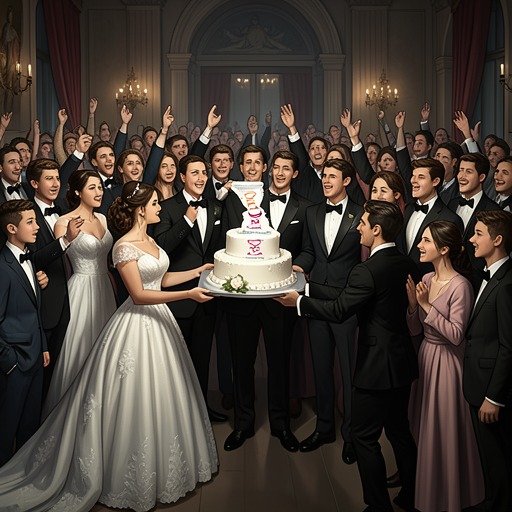
Tilly Killick and Malcolm Tidewell’s wedding
One DayTilly Killick and Malcolm Tidewell’s wedding is both a lavish early-thirties celebration and the occasion on which Emma Morley and Dexter Mayhew cautiously recover their friendship. Set against a culture in which weddings have become elaborate demonstrations of commitment, the event brings Emma and Dexter into the same room after years of missed conversations. Its decisive turn comes not at the ceremony but afterward, when a private talk in the grounds ends with their agreement to be friends again.
Background and the third wave
On Thursday 15 July 1999, in Somerset, wedding invitations have begun arriving in an apparently endless cascade of luxurious, quilted envelopes. The narration places Tilly’s wedding within a generational sequence. University weddings had been playful student performances: informal celebrations with secondhand clothes, pub-going and modest presents. Mid-twenties weddings retained some of that homemade spirit, though even then the wedding list had begun to appear. By contrast, weddings among people in their early-to-mid-thirties have become more professional, expensive and serious. No one is laughing at this third wave.
Its scale is conveyed through its material arrangements: complex invitations supply practical information about travel, clothing and gifts; country-house hotels are booked; marquees rise; formal morning suits, caterers, florists and hired entertainment become part of the occasion. The guests’ journey from ceremony to reception may involve open-topped buses, hot-air balloons, matching white horses or microlight planes. Even confetti has become a costly requirement. This comic catalogue gives the wedding a social significance beyond the marriage of two people: it makes commitment visible through elaborate planning, spending and participation, including time off work for guests.
Emma arrives alone
The invitation is addressed to “Emma Morley and partner.” At a motorway service station, Emma studies it in her new car, a fourth-hand Fiat Panda, and imagines the formal, expensive wedding to come. Her ancient road atlas is missing major conurbations; turning it around does not make it useful, and she drops it onto the empty passenger seat where her imaginary partner would have sat. The comic image also establishes her actual circumstances: she is making the journey alone to an event whose invitation has allowed for someone beside her.
She reaches the ceremony after it has begun, having driven barefoot and then struggled to force her swollen feet back into her shoes. As music plays in the chapel, she hobbles over the gravel and slips in at the back of the packed congregation. A performance follows a performance: an ensemble plays, an a cappella group sings, and the ceremony begins to resemble a variety show. Tilly wears a Marie Antoinette-inspired dress of pink silk and lace, with a hooped skirt and piled-up hair. Malcolm, whom Emma sees for the first time at the wedding, wears a pale grey morning suit. Emma notices the bride and groom’s evident happiness, even as the staged abundance of the day invites her wry scrutiny.
The reunion
From the back of the chapel, Emma sees Dexter counting on his fingers. He is there with Sylvie, his fiancée, who holds his hand during the vows. Dexter and Emma have encountered one another at weddings before, but their repeated promises to talk have not led to a real conversation. Their recognition here is therefore both familiar and unresolved. Emma notices Dexter’s smile toward Sylvie and his glance in her direction; the ceremony’s public display of a couple’s commitment sits beside the private history the two old friends have yet to address.
After the cabaret and the congregation’s uncertain attempt to sing “All You Need is Love,” guests follow the newly married couple outside. In the crowd of embraces and greetings, Emma and Dexter seek one another out. Their first exchange is spare and tentative: “Well,” he says, and she answers, “Well.” The brevity marks the distance between them without making their reunion a stranger’s meeting. They have found each other again, but must decide what that recognition can mean.
A conversation and a renewed friendship
Later, away from the reception, a familiar statue helps Emma recognize where they are in the grounds. Turning back would take them into the rose garden and then into the party, where Dexter’s fiancée and their friends are waiting. The approaching end of their privacy gives the conversation urgency. Emma feels a sudden sadness, stops, and takes both of Dexter’s hands. The gesture makes their encounter more than a polite exchange at a wedding: she is choosing to speak before the social occasion separates them again.
At last Dexter asks, “Friends again?” Emma answers, “Friends again,” lets go of his hand, and proposes that they find his fiancée so she can congratulate her. The exchange offers no claim that the past has been repaired or that everything between them has been settled. It does, however, replace their unrealized promises to talk with a clear, mutual decision to resume the friendship. The wedding’s public ceremony celebrates a marriage; its quieter consequence for Emma and Dexter is a renewed bond, acknowledged just before they return to the party.